Showing posts with label Croydon Airport Society. Show all posts

Monday, 14 March 2016

Flying Through the 30s: A one day symposium on air travel and interwar Britain.

16 April 2016
The Aerodrome Hotel, Croydon Airport
London

Programme

9:45 – 10:15 Coffee and Registration

10:15 – 10:30 Welcome Address
Peter Skinner (Croydon Airport Society): ‘History of Croydon Airport and the Jimmy Jeffs' Collection’

10:30 – 11:30 ‘Flying into the Unknown’
Luke Seaber (UCL): ‘“Upon its glittering lake /Lie Europe and its islands”: The     “Groundmindedness” of Auden and Others in the ’30s’
Daniel Kilburn (UCL): ‘A pilot’s perspective on the formation of modern airmindedness through the 1930s’
Henry K Miller (Cambridge/Anglia Ruskin/Slade): ‘Lumière Comes to Croydon’

11:30 – 11:45 Coffee and Tea Break
Jacky Pett will introduce her display of archival material and book about her father’s work with Imperial Airways in the 1930s.

11:45 – 12:45 ‘Aviation Fever’
Rebecca Harrison (UEA) and Rachel Kapelke-Dale (UCL): ‘Sweethearts of the Skies:     
Gender, National Identity and the “Aviatrix”’
Kathryn Simpson (Cardiff Metropolitan University): ‘Taking Flight: The Literal and Literary          Flights of Lady Mary Heath and Virginia Woolf’
Francis Dyson (UEA): ‘Egypt and Back with Imperial Airways: Ruth Stuart's Passion for Air         Travel’

12:45 – 13:45 Lunch

13:45 – 14:30 Tour of Croydon Airport and Museum

14:30 – 15:45 ‘Tension in the Air’
Derek Ryan (University of Kent): ‘Bunny in the Air: David Garnett, Flight and Animality’
Sarah Fill (Royal Holloway): ‘The Aerial Vision of Paul Nash’
Simon Goulding (Birmingham and Solihull Mental Health Foundation Trust): ‘Look to the           Skies! Orwell, Warner and the Coming New War’
John Higgins (University of Stirling, retired): ‘A Novelist's View of Flying for Fun’
           

15:45 – 16:00 Coffee and Tea Break

16:00 – 17:00 ‘Flying Business’
Michael McCluskey (UCL): ‘Croydon Calling: The Documentary Aerodrome’
Nicola Darwood (University of Bedfordshire): ‘Flying Dangerously: Elizabeth Bowen’s To the       North’
Guy Woodward (Maynooth University): ‘A Solar Emperor: Robert Byron Flies East’

17:00 – 17:30 Roundtable Discussion
All presenters and audience members are invited to speak about the day, share memories and stories of Croydon Airport, make connections between papers, and consider ideas for future collaborations.

Registration
£35 Standard
£30 Speakers
£25 Students

Registration fee includes three-course lunch, coffee and tea breaks, and tour of the Croydon Airport Museum.

To register: http://onlinestore.ucl.ac.uk/   (Search: Flying through the ’30s)

How to get here:
The symposium will be held at The Aerodrome Hotel (part of the Hallmark Hotel chain), Purley Way, Croydon, CR9 4LT

The hotel is just next to the Croydon Airport Visitor Centre.

By Train
Waddon is the nearest station and a 10 minute walk to the hotel/airport. We have found this to
be the most direct route from London. Trains leave from Victoria, and Oyster cards are acceptable to Waddon and on return. Out of Waddon Station turn right then turn left onto Purley Way. The Aerodrome Hotel will be on right.  The 289 bus also goes from Waddon Station to Croydon Airport.

Purley is 10 minutes from the airport/hotel by 289 bus.

East Croydon is 20 minutes from central London and then 15 minutes to the airport/hotel by the 119 bus.

By Bus
Bus routes that serve Croydon Airport are the 289 and 119. Buses stop outside Croydon Airport/TheAerodrome Hotel or across the road at The Colonnades.

Organisers
Dr Michael McCluskey (UCL)
Dr Luke Seaber (UCL)
Dr Amara Thornton (UCL)
Dr Debbie Challis (Croydon Airport Society)

Questions?

flyingthroughthethirties@gmail.com

Monday, 4 January 2016

Academic Symposium on Croydon Airport in the 1930s

The first academic symposium on Croydon Airport (that we know of anyway) is going to be held on 16 April 2016 at the original Aerodrome Hotel (Croydon Hallmark) next door to the airport. We are very excited about this as it is an opportunity to explore the history of the airport across lots of different areas with expert minds.

Thursday, 22 October 2015

Captain Franklyn L. Barnard & Cataloguing

Graham and Malcolm checking the material
One of the tasks the Hidden Heritage of Croydon Airport project is doing is getting our archives in better order. Some of the files that have a great deal of historical material, i.e. original material such as letters, log books and photographs, have been repacked into archive boxes. Now intrepid volunteers Graham and Malcolm have started cataloging the material in the boxes for cross references and so each box can have an inventory.

The first file they are doing is the file of Captain Franklyn Leslie Barnard. Barnard's file contains his logbooks from World War One through to his last flights in 1927 as well as letters, many photographs and even some cuff links.

Barnard was born in 1896 and joined the Royal Flying Corps in June 1916 but was struck down
after only a few months in the air, attempting to save a fellow airman. He returned to active service in 1918. After the war Barnard became chief pilot for Instone Air Line and then for Imperial Airways from 1924, for whom he piloted many pioneering passenger routes, such as to Cairo (1924) and further afield to Delhi (1927). His file is full of photographs, such as the one to the right, showing people he had flown or was about to fly to exotic places, often signed. This one is unusual in depicting a famous sight rather than an airport or aerodrome. 

Barnard is perhaps most well known for winning the first Kings Cup Race on 8 September 1922. The Kings Cup Race was a race from Croydon airport to Glasgow, a night's stop and then back again the next day. It was began by King George V to encourage aircraft design and engineering. Barnard won it again in 1924 but there'll be more on the Kings Cup Race in another blog.

In cataloguing Barnard's file we have found menus, lots of postcards and invitations which ave given an insight into the life of a distinguished pilot in the 1920s. One permit gives Barnard permission from the Swiss government to carry a firearm while flying gold bullion through the country's airspace. Clearly a pilot had to act as security as well in such missions.

Barnard died in a flying accident in July 1927, while testing an aircraft for another go at the Kings Cup Race. It was a tragic loss to civil aviation and the number of condolences to his widow in the file illustrate how deeply he was mourned by pilots and people connected to aviation across the world.

Monday, 27 July 2015

The Railways Take Off . . .

A post from Mike Homewood from our U3A group about some surprising reminiscences from a friend:

A chance remark to an old friend about Croydon Airport, revealed he had worked for Railway Air Services Ltd at Croydon Airport, in 1946. I had no idea that the Railways had run an airline, so a look through the archive at the Croydon Airport Society and all was revealed.

Monday, 20 July 2015

“The fascination and comfort of Silver Wing travel”

Interior of Scylla (a postcard in the collection of Croydon Aiport Society)
This slogan is how Imperial Airways chose to advertise their Silver Wing service from Croydon to Paris in the 1930s. The fascination was in the thrill of flying itself. As the planes flew at a lower level in those days, the whole flight was viewed as a unique sight-seeing experience and the thrill of being airborne was very exciting and sometimes a little daunting to first-time flyers. (Neville Chamberlain, on returning from his visit to Hitler in 1938, commented that his first experience of flying had been ‘not as bad as he had been led to believe’ and that he had travelled very comfortably.) 

Friday, 17 July 2015

Channel Hopping for High Flyers

A blog on the prestige of flying to Paris from Cheryl Bailey, one of our U3A project team:

Passengers taking a return flight to Paris in the 1930s paid just £6 15s. which sounds not like a great deal to us today but of course in those days it was a lot of money. The average skilled workman only earned around £4 a week so airborne channel-hopping was only accessible to very successful people – politicians, big businessmen, celebrities of stage and screen and the very well-off. The staff on the planes loved spotting famous faces on board especially if they were known to be big tippers. Sometimes their names were even added to the pilot’s log.

Sunday, 12 July 2015

"The Suburbs shall shake at the sound of the cry of thy pilots " Ezekiel xxvii 28

Image of crash on 9 September 1936
A prescient post from U3A project member Peter Day explores the potential dangers of living near to Croydon Airport:

The positioning of airports was as controversial in the 1930s as it is today. Low flying, night flying, noisy engines - and crashes, all contributed to a degree of ill-will from local residents. In the case of Croydon this came to a head on the morning of December 9th 1936. On that foggy morning a KLM DC2 crashed into houses near the airport shortly after take-off resulting in the deaths of 15 passengers and crew. This was the worst air accident there had been in the UK in terms of the number killed and a storm of protest blew up with questions in Parliament, local protest meeting and petitions to the Air Ministry.

Friday, 10 July 2015

1950s Tourism in North Africa

There are times when rummaging through an archive you find a document that has contemporary poignancy that has little to do with the document's original production or context. 

This is true of this brochure 'You can no longer ignore North Africa' that advertised tourism in Morocco, Tunisia and Algeria in 1951. Sara, a volunteer for Croydon Airport Society, and I found it when doing a brief condition assessment of the Air France file.

Tuesday, 7 July 2015

Jean Batten – The Garbo of the Skies. A young Croydon boy’s recollection.

This week we have a post from a member of our University of the Third Age Shared Learning Team - Mike Homewood.

Within the books and papers of the Croydon Airport Society is this copy of the recently discovered Flying Licence of New Zealand aviatrix Jean Batten. Also the film star like pose, which added an extra glamour to the early female flyers. No wonder a small boy and his father were eager to get a glimpse of this flying icon of the age.

Image: Flying Licence Croydon Airport Society (Donated by Mrs Dunn)

Peter Sherman’s Recollection (29 June 2015)

October of 1937, I was a lad of 7 years, living at 53 Miller Road West Croydon. A regular treat in those days was to walk with dad to Croydon Airport on a Sunday morning, to watch the rich and famous people coming and going. On this particular day we were expecting the arrival of Jean Batten from Paris after another record breaking flight (Australia to Croydon in 5 Days 18 Hours).

This was an important event so dad paid up for the two of us to go onto the roof of the Aerodrome Hotel (three pence for him and one penny for me ). Dad got me to go in front with him behind, the Tannoy then told us that the flight was delayed in Paris due to fog. Half an hour went by, another Tannoy announcement (still delayed but fog might clear soon). Dad started to worry that we may be late for Sunday lunch, in our house it was the most important event of the week, The only time we all sat down together, Mum, Dad, two older sisters and me, and NOT TO BE MISSED FOR ANY REASON! 

Another Tannoy Message: Miss Batten had just left Paris (loud cheering from the crowd), she should arrive in about 50 minutes. 'OK', says my Dad, 'We will wait'.

At long last the sound of a light aircraft. The little plane landed without a hitch and taxied on to the apron just below us. A little lady in a big leather coat and white helmet started to get out. A huge crowd began to gather around the plane (it was estimated there were over 10,000 people there that day). A Band started to play (I think it was Rule Britannia).

There seemed to be lots of hugs and kisses! All a bit much for a 7 year old. Suddenly it was all over, Dad looked at his watch, Oh Lord it's nearly 3 o’clock, now we will be for it. We hurried down the stone steps of the Aerodrome Hotel and along to the bus stop, WOW, we are going home by bus another treat.

I had never really seen mum really cross. She let dad know how she felt! But I can still remember his smart reply: 'We have seen History made today! A proud day for Britain and, any way, it's all part of the lad’s education'.

Post by Mike Homewood from a recollection by Peter Sherman, Barton on Sea Hampshire.

Thursday, 2 July 2015

Flying to the Past: Croydon to Persepolis - New Event Announcement

Olley Expedition Photograph,
Persepolis (Croydon Airport Society)
If any of you enjoyed the blog on Aerial Photographs of the Middle East in the 1930s, you can come and find out more at an event on Saturday 26 September where the film the flight was made for will be screened.

The ancient past meets modernism with a juxtaposition of 1930s aerial photography, film, archaeology, celebrity pilots and archaeologists. Come to Croydon Airport to find out more about lost empires and the people who recorded their excavation.

Monday, 29 June 2015

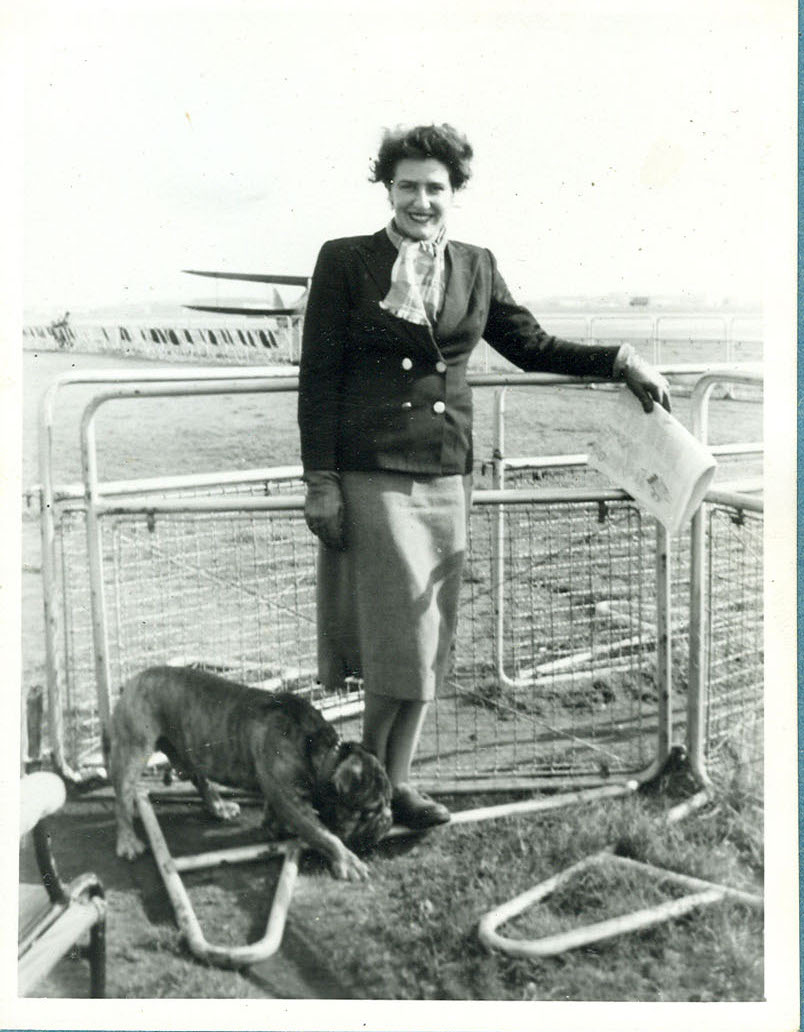
Monique Agazarian and her bulldog

Monique Agazarian and Spike, 1952
Among the images in the archives is a photograph of Monique Agazarian and her beloved bull terrier Spike, a dog who loved flying. Listening to a recording of Agazarian giving Croydon Airport Society a lecture a few years before her death in 1993 and reading about her in the archives, she was clearly a formidable and witty woman. In fact, I'm too awed to refer to her as "Aggy" as some of the archive material does.

Agazarian (1920-93) and her three brothers became obsessed with flying from the time their mother installed an old Sopwith Pup plane in their garden in 1923. Her brother Noel was in the RAF, fought in the Battle of Britain and was killed in the Middle East in 1941. (The Spitfire in which he fought is in the Imperial War Museum). Another brother Jack worked for the Special Operations Executive and was tortured and killed by the Nazi occupiers after being caught helping the Resistance in France. Her third brother Levon became a Typhoon pilot. 

Monday, 22 June 2015

Soviet Man in Space

Front Cover and signature
This week we have a guest post from space and SF geek Simon Guerrier:

Amid the books and papers in the archives of the Croydon Airport Society is “Soviet Man in Space”, published in May 1961. The cover boasts a simple illustration of a man in a spacesuit gazing through a porthole at the pale blue Earth. Except someone has defaced the cover – there's something written in black ink over Europe and north Africa. It's the autograph of Yuri Gagarin, the first man in space.

We don't know how this prized autograph was obtained. Gagarin visited the UK in July 1961 but he flew in to and out from Heathrow. The handwritten archive number CAS 521/99/003, written inside the booklet, tells us that

it was bought in 1991 from the estate of Group Captain Patrick Tweedie (1902-90). Tweedie was vice-president of the Croydon Airport Society when it was formed in 1978 and had a long career in aviation in the RAF, Imperial Airways and as an Inspector of Air Accidents. He was Chief Inspector of Civil Aviation 1953 - 1962, so perhaps he met Gagarin on his UK visit. There will be more about the fascinating life of Captain Tweedie in a forthcoming post, but we don't know how he acquired this signed copy of “Soviet Man in Space”. (If you can tell us, please get in touch.)

Monday, 15 June 2015

Aerial Photographs of the Middle East in the 1930s


The expedition team from the Oriental Institute in Chicago.
Olley expedition photographs, Croydon Airport Society
One of the best aspects of working in archives and with museum collections is the unexpected things you can find. Peter Skinner, archivist for the Croydon Airport Society, knowing my interest in archaeology and the Middle East pointed me to some photographs in a file named 'Expeditions'. I was amazed to find photographs of excavations at Khorsabad and Persepolis as well as a number of aerial photographs of the area of (to use the names used then) Palestine, Trans-Jordan, Egypt, Iraq and Persia from 1932 or 1933.

Wednesday, 10 June 2015

Our Archives

This is a new blog from Croydon Airport Society to share stories, pictures and snippets from its rich archive about people, planes and events. It is part of the Revealing the Hidden Heritage of Croydon Airport project, which has been funded by the Heritage Lottery Fund. It is called 'Croydon Calling' as the phrase and the airport was famous in the 1920s and 30s when it was Britain's only international airport.

Josephine Baker with Captain Walter Roger, 1928
Just as an example, this is a photograph from the files of a pilot, Captain Walter Rogers who flew planes for Imperial Airways and shows him with stage star and artist Josephine Baker in 1928 at Croydon Airport. There will be much more information coming up on an event around another group of photographs showing Baker shortly.  . .

Many of the images in the archive have unknown photographers or are press agency photographs: part of what we are doing is working out which images we can share online. We think this photograph was taken for Captain Rogers privately by an unknown photographer and thus is an 'orphan work'. If anyone knows any differently, please let us know!

Josephine Baker

Josephine Baker arriving at Croydon Airport in 1928.
 Photograph Croydon Airport Society archives
Our first post revealed a photograph of Josephine Baker with Captain Rogers. We know, however, that Captain Gordon P. Olley actually picked Baker up from Paris in 1928. In his autobiography A Million Miles in the Air. "Adventure is still with us" (1934), Olley recalls going to her flat in Paris and persuading Baker to accompany him to London in a plane especially chartered for the occasion. She was reluctant as she had sprained her ankle.

However, Josephine Baker agreed to go with Olley to London for the charity gala and Olley said as I flew her back to Croydon:
Miss Baker .. . made light of her sprained ankle - although I could see it was really paining her a great deal. 

Baker made it to the West End from the airport in good time and sang and danced on stage, where she got a rapturous reception due, in part according to Olley, to the audience knowing about her 'air dash and injured ankle.  

If you would like to know more, join historian Dr Gemma Romain at Croydon Clocktower on Thursday 8 October to find out why performer, singer and actor Josephine Baker made a flying visit to Croydon Airport in 1928. Croydon Airport was at the heart of the cultural world of 1920s & 30s London. The talk will explore the often unacknowledged integral part that Black artists, musicians and activists played in creating this vibrant cultural world.

Gemma Romain is a historian and researcher based at The Equiano Centre, University College London. Her work explores Caribbean and Black British history, with a particular focus on Black LGBTQ histories. Her biography of Patrick Nelson, a black gay artist model and student in interwar London will be published by Bloomsbury Academic. She is also co-curator of Spaces of Black British Modernism, which is on display at Tate Britain until 4 October 2015.


Thursday 8 October 6-7pm. Free Booking essential via eventbrite.