Monday, 12 March 2018

Air Raid Defences in and around Croydon: Timeline

4 August 1914: Britain declares war on Germany

24 August 1914: Special Constables start guarding “vulnerable points” including water, gas and electricity works; telephone exchange; railway bridges (later gradually reduced to release manpower for air raid duties)

19 January 1915: first time Special Constabulary alerted for air raid

13 October 1915: raid by Zeppelin L14 Kapitanleutnant Bocher. Bombed Croydon. 9 killed, 15 injured


Monday, 5 March 2018

Public Reaction in Croydon to the Zeppelin Raids of October 1915

Norman, one of our volunteers on the Fighting for Air project, discovered a very interesting and important item in the Museum of Croydon. A handbill for a public meeting only a week after the devastating raid of 13/14 October. Norman writes:

Bomb damage at 69-73 Stretton Rd Croydon, at which 3
people were killed: Eliza Walter (52), Daisy Walter (23) and
Sidney Walter (15). Photograph Home Office October 1915.
© IWM (HO 29)
The actual number of casualties and material damage caused by the first Zeppelin raid were totally insignificant in terms of military losses on the Western Front and elsewhere. The Commonwealth War Graves Commission records the deaths of 1,074,612 service personnel between 4 August 1914 and 11 November 1918 – an average of 689 for every single day of the Great War. And as the Prime Minister pointed out in a debate in the House of Commons on “Home Defence”, more Londoners died from traffic accidents in the blackout than from enemy action.

But the public did not see it that way. These were innocent and defenceless women and children, slaughtered in their beds as they slept.  Anti-German feeling ran high. These were “Baby Killers” and anybody with a Germanic-sounding name was a potential spy. Shops owned by these people were ransacked whilst the British Bobby stood passively by.

Croydon reacted by calling a public meeting, chaired by the Mayor, on 22 October 1915. Two motions were passed:

Mr William Joynson-Hicks M.P. proposed and Lord Willoughby de Broke seconded called for reprisal raids by British aircraft against German cities as the only effective means of defence against Zeppelin attacks.

The second motion was proposed by the Editor of the Globe, Mr Charles Parker, calling for an independent air arm to replace the separate Royal Flying Corps (Army) and the Royal Naval Air Service. In this, he was two years ahead of the official report to the Government of 1917 by General Smuts which, when accepted, led to the creation of the Royal Air Force on 1 April 1918.

Monday, 26 February 2018

Capt. L. M. Barlow: The ‘Gadget King’ and Local Hero

Captain Leonard Monteagle Barlow, who lived in Onslow Gardens Wellington  was brought
to our attention by Lorraine (one of the project volunteers) as he was local to the airport, had achieved an enormous amount but tragically died when at only 19 years old. Barlow was awarded MC three times. He was nick-named the Gadget King designed and had installed mechanism for firing both guns together with one trigger. He also flew from Beddington (Croydon) airfield on occasions.

More information was then provided about him by his nephew Ian Leonard Stimson who, coincidentally to this project, came to the February Open day at Airport House. Fortunately he got chatting to our volunteer co-ordinator Karen and then emailed details of his uncle afterwards. Ian Leonard Stimson – his middle name is after his heroic uncle – has researched this young pilot for his family history and sent links to more information about him in the squadron history.

Monday, 19 February 2018

People and Crashes at Beddington

Herbert Montgomery Martin records many crashes.  The aerodrome was home to Training Squadrons from May 1916 until the end and beyond of the war; No. 17 Training Squadron in May 1916, then No. 40 Training Squadron from 1 June 1916 until 14 December 1918. A great example is this one of Lt. Neisding, showing a Sopwith Camel in trees, in Beddington in January 1918. You can see the ladder in place to rescue the pilot.

Thursday, 15 February 2018

Herbert Montgomery Martin


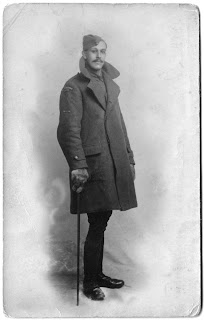
H M Martin in uniform with cane. 
The photographs of Croydon by Herbert Montgomery Martin illustrate many of the activities, crashes and people working on Beddington / Croydon Aerodrome in the last year of the First World War. There are several images of Montgomery Martin himself, who joined the army on 20 July 1916 (the Royal Flying Corp was then part of army). It is not clear from his service record if he joined the Flying Corp immediately, but it notes his transfer to the RAF on its formation on 1 April 1918.


Martin was an ‘Observer’, which meant he primarily worked as aircrew on reconnaissance observing and / or taking photographs of enemy positions. The photographs preserved by Cross and Cockade, which HCAT have copies of, make sense of this. The next blog explores some of the people Martin photographed.


Elizabeth Mary Byers

The service record tells us that he married Elizabeth Mary Byers, who was in the Women’s Royal Naval Service. She enlisted on 6 May 1918 (G2042) and worked as a waitress (according to livesofthefirstworldwar.org).


They married at St Saviour’s Church in West Croydon on 2 August 1919, by which time Martin had transferred to RAF reserve in February the same year 1919 and is wearing the badge of an ‘Observer’ in the photograph below.


Sunday, 11 February 2018

Tragedy at Croydon's Tank Day 1918

On a previous post giving some glimpses of Croydon in 1918 through Herbert Montgomery Martin's photographs, I mentioned that there was a tragic crash during the Tank Day. On 16 March people were invited to subscribe to the Victory Loan - basically contributions to the war effort - and the presence of a tank, a new war machine, encouraged these investments. The day was overshadowed by the death of a young pilot at Croydon.

Monday, 5 February 2018

The Gosport System: Robert Smith-Barry and Pilot Training

The Avro Biplane - pictured at Gosport - was Barry-Smith's preferred aircraft
for instruction as it was easy to fly so the pilots could concentrate on
learning tactics. This is from Landowne Album 3.
Training pilots to fly planes - at first for reconnaissance and then for fighting - was a dangerous and haphazard affair; of the 14166 pilots killed, over half died in training. By mid 1916 there was a dangerous shortage of pilots. The Royal Flying Corp (RFC) training programme taught pilots to fly but not to fly in battle or attack. Major Robert Smith-Barry constantly asked General Trenchard (head of the RFC in France) to let him try a new, more rigorous training programme.