Showing posts with label photographs. Show all posts

Monday, 9 April 2018

Mapping the Aerodrome in the First World War


Roger Potten is one of our highly skilled archive volunteers who has been working on rebuilding the first Croydon Airport (1919-1927) on a platform called Sketch Up. This software enables the building of architecture to create sophisticated 3 dimensional reconstructions with intricate detail and texture.
First airport tower, 1923

When the Heritage Lottery Fund awarded Historic Croydon Airport Trust a grant to investigate the first world war origins of what became Croydon Airport, Roger turned his attention to 1916-1918. He began building up a reconstruction what started as an airstrip overshadowed by the farm on Plough Lane in 1916 to a large RAF training aerodrome, complete with bombing practice range, by 1918. In doing this Roger has found the photographs of Herbert Montgomery Martin, previously blogged, invaluable for building up an accurate picture of the layout of the airfield and aerodrome and the intricate details needed for the added texture. This blog shares the maps that Roger has pieced together of the airfield and aerodrome from 1917-1919.


By summer 1918 the training airfield had grown dramatically and surrounds the farm with a camp now on the farm side of Plough Lane. The Training Squadron was still growing.


Shortly after the war ended, the RAF (newly formed on 1 April 1918) was still using the airfield and aerodrome for training purposes and for taking civilians and politicians to Paris for the Versailles war treaty negotiations. The farm is now entirely overshadowed and Plough Lane is clearly a barrier in the aerodrome.


By 1920, the aerodrome was designated for civilian transportation and became an airport, i.e. having a customs and excises for duty on imported and exported goods.


Thursday, 15 February 2018

Herbert Montgomery Martin


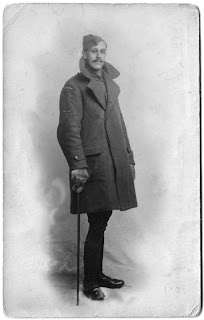
H M Martin in uniform with cane. 
The photographs of Croydon by Herbert Montgomery Martin illustrate many of the activities, crashes and people working on Beddington / Croydon Aerodrome in the last year of the First World War. There are several images of Montgomery Martin himself, who joined the army on 20 July 1916 (the Royal Flying Corp was then part of army). It is not clear from his service record if he joined the Flying Corp immediately, but it notes his transfer to the RAF on its formation on 1 April 1918.


Martin was an ‘Observer’, which meant he primarily worked as aircrew on reconnaissance observing and / or taking photographs of enemy positions. The photographs preserved by Cross and Cockade, which HCAT have copies of, make sense of this. The next blog explores some of the people Martin photographed.


Elizabeth Mary Byers

The service record tells us that he married Elizabeth Mary Byers, who was in the Women’s Royal Naval Service. She enlisted on 6 May 1918 (G2042) and worked as a waitress (according to livesofthefirstworldwar.org).


They married at St Saviour’s Church in West Croydon on 2 August 1919, by which time Martin had transferred to RAF reserve in February the same year 1919 and is wearing the badge of an ‘Observer’ in the photograph below.


Monday, 29 January 2018

Gosport Photographs: Keith le Geyt Lansdowne 1897 - 1984

Keith le Gent Lansdowne aged 17 in 1914 from album 3
Historic Croydon Airport Trust is extraordinarily fortunate to have 3 albums of original photographs taken (mainly) at Gosport 1916-18. They are among the Trust's archival 'crown jewels'. We  knew very little about them before now but can add some information about Keith Lansdowne, who donated them. They have been digitised due to funding given to  this Fighting for Air project from the Heritage Lottery Fund.

The photographs appear to have been (mostly) taken by Keith le Geyt Lansdowne, who was born 1897 and served in the Royal Flying Corp then Royal Air Force as an electrician and mechanic. It is likely that he was transferred within the army from his original regiment, where he'd seen action in Belgium, due to the need for electricians in the enlarging RFC.