Showing posts with label First World War. Show all posts

Monday, 30 April 2018

Bonds not Bombs in Croydon: German War Reparations

Almost 7 years after the end of the First World War, Croydon Airport played a role in its economic aftermath when an aeroplane landed with £9,660,000 worth of bonds as part of Germany’s war reparation payment. The treaty of Versailles and then further treaties set an enormous bill for Germany officially named as the aggressors, then losers, in the war.

Illustrated London News, 5 September 1925, f.5


The plane flew from Amsterdam to London on 25th August 1925. It was of interest partly as it was a new Swedish Junkers Type F.24 with triple engine and all metal – the first to land in Britain. It and the pilot had been chattered by the German government to convey the money to Britain. One of our project volunteers, Cassie Pope explains more about the reparations. . .

How much was Germany expected to pay?

The London Ultimatum of 1921 set the total German war reparations cost at 132 billion gold marks. This total was made up of three categories known as A, B and C bonds. The burden of this bill amounted to over 260% of Germany's GDP in 1913. It was decided that the C bonds, valued at 82 billion gold marks, wouldn't realistically be paid. This left the total around 50 billion gold marks, which did not significantly exceed Germany's expectation of a bill between 30 and 40 billion.

Germany Defaults

Almost from the start, Germany fell behind on deliveries of timber and coal, which were accepted as one form of payment. By 1923, the scale of Germany's default led to the occupation of an area of the industrial Ruhr region by French and Belgian forces. With its industrial heartland crippled, the German economy teetered on collapse.

The Dawes Plan
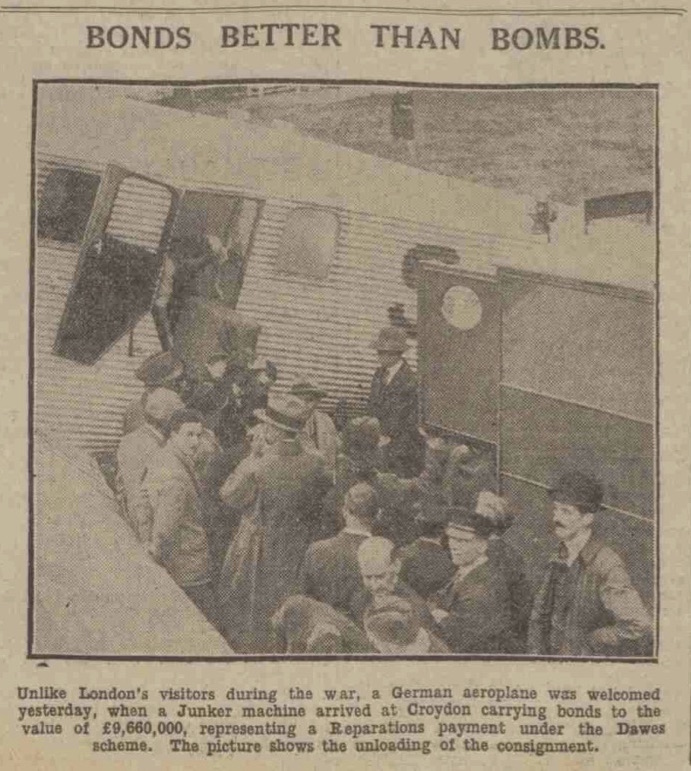
The Leeds Mercury, 26 August 1925
The German economy was faltering, and a commission was formed to reexamine the reparations schedule. The resulting Dawes Plan of 1924 reorganised the repayment schedule but did not reduce the total amount. The new schedule called for an initial reduction of German yearly repayments, which would then pick up as the economy improved, reaching a steady rate by 1929. Germany would also receive $200 billion in foreign loans, predominantly through bonds issued by the United States.

Prior to 1925 German reparations predominantly took the form of payments in kind. After 1924 the proportion of payments in foreign currency increased.

German Payments in the First Year

First year of the Dawes Plan ran from 1st September 1924. The first annuity amounted to 1,000,000,000 gold marks, which was paid within the year into the account of the Agent General for Reparations Payments with the Reichsbank. Four-fifths (800,000,000) of this amount was paid out of the proceeds of external loans. One-fifth (200,000,000) was paid from the bonds of the German Railway Company.* 

The Railway Company made its payment in two installments of bonds. The first, totaling 100 million gold marks, was paid on February 28th, 1925. The second, installment of 100 million gold marks was due on September 1st, 1925. This payment was made in advance, with 40 million paid on August 1st, and the balance of 60 million paid on August 31st.  

'The Plan generally is functioning smoothly, and all those concerned in its execution have worked together loyally and in a spirit of friendly accommodation.'


It is this last installment that is arriving in Croydon Airport. For security G. H. J Jeffs, a British observer was also on the aircraft, who wrote a report for the Civil Aviation Traffic Office on landing. As the newspaper put it, it was Bonds not Bombs that were coming from Germany now.

By Cassie Pope

*Information taken from Report of the Agent General for Reparations Payments. November 30th, 1925. London, His Majesty's Stationery Office 

Wednesday, 25 April 2018

Reconstructing the First World War Aerodrome: Wooden Huts behind C Hanger

Continuing with our virtual tour of the Croydon Aerodrome in the First World War, below are images of the wooden huts and area behind C Hanger:


Monday, 19 March 2018

Killed by a propeller: Sad accident to Air Mechanic

Lorraine has found a reference to an air mechanic, not on our Roll of Honour (air men who died at or around Croydon aerodrome during the war). Although the article does not detail that the accident took place at Croydon / Beddington, the location of the Crescent War Hospital in Thornton Heath makes it unlikely to be elsewhere. From the Croydon Advertiser and Surrey County Reporter, Sat. 29 March 1918:

A keen air mechanic, Henry Colin Lane, aged 29, met with his death through his keenness to ascertain if the engine of an aeroplane which he had just set in motion was running properly.

Ground crew at Beddington / Croydon in 1918.
H M Martin Photograph.
The story was told to the Croydon Coroner and jury at an inquest at the Union Offices on Tuesday afternoon, when Jack Liennewiel, a fitter in the RFC, described what occurred.  Deceased was assisting another air mechanic to start the propeller of a machine. There was another machine with the engine working about fifteen feet away.  After assisting to start the propeller deceased walked sideways into the propeller of the other machine, his attention being entirely devoted to the machine he had just started.  The propeller struck him on the head, knocking him down.  The engines were at once stopped and he was removed to the medical officer and then sent in an ambulance to the Crescent War Hospital.  Witness thought deceased did not realise that the other machine was in action, as he could not hear it owing to the noise of the machine he had just started. 

Flight Sergt. Alexander Vaile gave a similar description of the accident.

Capt. Edgar Willett RAMC, attached to the Crescent War Hospital, said that when deceased was brought to the Hospital he was able to tell him his name.  Witness had him at once taken to the operating theatre and there found that he had a large scalp wound and four smaller one, and his arm was also injured.  Witness could not find at the time any fracture of the skull. The wounds were cleaned and dressed and he was got to bed.  He was in a serious condition, and more serious at eleven o’clock, but witness did not think he had any injury he could not recover from.  About a quarter of and hour later, however, he suddenly collapsed and died.  A post-mortem examination the next day showed that there was no injury to his head from which he could not have recovered, but the liver was ruptured, and from this he could not possibly have recovered.  The propeller had also struck his side and broken some of his ribs and also caused a small rupture of one lung.

Sister Florence Lyal Wilson, the night superintendent at the Crescent War Hospital, said that deceased was never left.  He was seen by Capt. Selby, RAMC, at ten o’clock and again by Capt. Willett, at ten to eleven.

The jury found that death was the result of an accident.


(died 22nd March 1918)

Monday, 5 March 2018

Public Reaction in Croydon to the Zeppelin Raids of October 1915

Norman, one of our volunteers on the Fighting for Air project, discovered a very interesting and important item in the Museum of Croydon. A handbill for a public meeting only a week after the devastating raid of 13/14 October. Norman writes:

Bomb damage at 69-73 Stretton Rd Croydon, at which 3
people were killed: Eliza Walter (52), Daisy Walter (23) and
Sidney Walter (15). Photograph Home Office October 1915.
© IWM (HO 29)
The actual number of casualties and material damage caused by the first Zeppelin raid were totally insignificant in terms of military losses on the Western Front and elsewhere. The Commonwealth War Graves Commission records the deaths of 1,074,612 service personnel between 4 August 1914 and 11 November 1918 – an average of 689 for every single day of the Great War. And as the Prime Minister pointed out in a debate in the House of Commons on “Home Defence”, more Londoners died from traffic accidents in the blackout than from enemy action.

But the public did not see it that way. These were innocent and defenceless women and children, slaughtered in their beds as they slept.  Anti-German feeling ran high. These were “Baby Killers” and anybody with a Germanic-sounding name was a potential spy. Shops owned by these people were ransacked whilst the British Bobby stood passively by.

Croydon reacted by calling a public meeting, chaired by the Mayor, on 22 October 1915. Two motions were passed:

Mr William Joynson-Hicks M.P. proposed and Lord Willoughby de Broke seconded called for reprisal raids by British aircraft against German cities as the only effective means of defence against Zeppelin attacks.

The second motion was proposed by the Editor of the Globe, Mr Charles Parker, calling for an independent air arm to replace the separate Royal Flying Corps (Army) and the Royal Naval Air Service. In this, he was two years ahead of the official report to the Government of 1917 by General Smuts which, when accepted, led to the creation of the Royal Air Force on 1 April 1918.

Monday, 26 February 2018

Capt. L. M. Barlow: The ‘Gadget King’ and Local Hero

Captain Leonard Monteagle Barlow, who lived in Onslow Gardens Wellington  was brought
to our attention by Lorraine (one of the project volunteers) as he was local to the airport, had achieved an enormous amount but tragically died when at only 19 years old. Barlow was awarded MC three times. He was nick-named the Gadget King designed and had installed mechanism for firing both guns together with one trigger. He also flew from Beddington (Croydon) airfield on occasions.

More information was then provided about him by his nephew Ian Leonard Stimson who, coincidentally to this project, came to the February Open day at Airport House. Fortunately he got chatting to our volunteer co-ordinator Karen and then emailed details of his uncle afterwards. Ian Leonard Stimson – his middle name is after his heroic uncle – has researched this young pilot for his family history and sent links to more information about him in the squadron history.

Thursday, 15 February 2018

Herbert Montgomery Martin


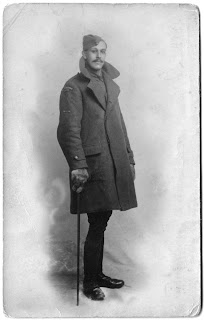
H M Martin in uniform with cane. 
The photographs of Croydon by Herbert Montgomery Martin illustrate many of the activities, crashes and people working on Beddington / Croydon Aerodrome in the last year of the First World War. There are several images of Montgomery Martin himself, who joined the army on 20 July 1916 (the Royal Flying Corp was then part of army). It is not clear from his service record if he joined the Flying Corp immediately, but it notes his transfer to the RAF on its formation on 1 April 1918.


Martin was an ‘Observer’, which meant he primarily worked as aircrew on reconnaissance observing and / or taking photographs of enemy positions. The photographs preserved by Cross and Cockade, which HCAT have copies of, make sense of this. The next blog explores some of the people Martin photographed.


Elizabeth Mary Byers

The service record tells us that he married Elizabeth Mary Byers, who was in the Women’s Royal Naval Service. She enlisted on 6 May 1918 (G2042) and worked as a waitress (according to livesofthefirstworldwar.org).


They married at St Saviour’s Church in West Croydon on 2 August 1919, by which time Martin had transferred to RAF reserve in February the same year 1919 and is wearing the badge of an ‘Observer’ in the photograph below.